
In this article
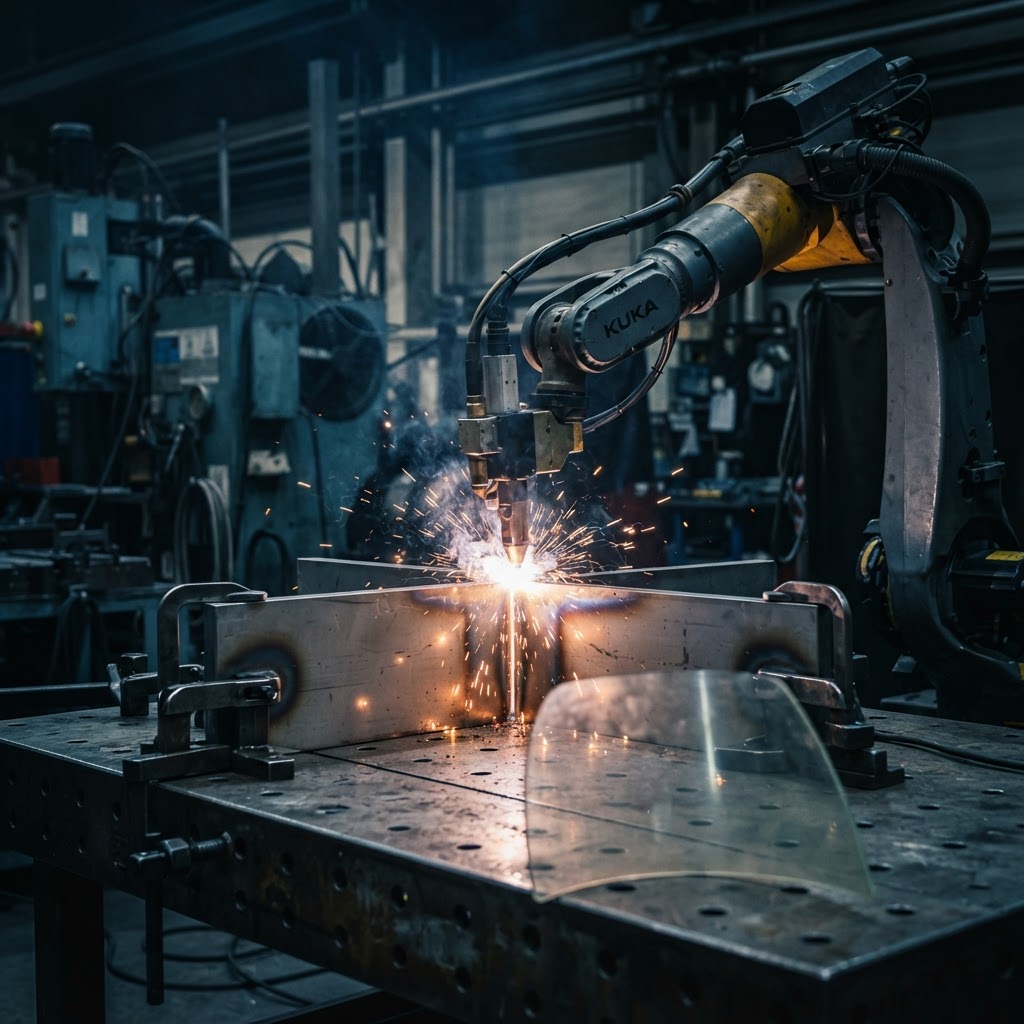
A safe laser welding installation needs a compliant machine, effective protection around the process, and a working method that keeps people within the exposure limits. CE marking addresses product conformity. The employer must also establish that the installed equipment can be used safely at the actual workplace. These are separate responsibilities. 1
This guide covers industrial laser welding in the EU, with particular attention to Dutch workplace duties and handheld systems. It explains what to check, rather than certifying any particular machine.
Dutch update — 10 November 2026: Metaalunie reported on 9 October 2026 that uncertainty remains about suitable protective clothing and gloves for handheld laser welding. It is discussing technically substantiated solutions with suppliers, safety specialists and the Nederlandse Arbeidsinspectie. According to Metaalunie, the Inspectorate is scrutinising whether employers can demonstrate adequate risk control. This report is not a blanket legal ban, but it is a reason to demand evidence for operator protection. 2
1. Enclosed welding and handheld welding are different safety cases
A powerful laser source can be incorporated into an enclosed machine whose accessible emission is Class 1 during normal operation. That classification depends on the complete product and its protective measures. Opening guards for service can expose a different hazard, so maintenance needs its own controls. Classification concerns accessible laser radiation; it does not establish that fumes, fire or electrical risks are controlled. 3, 4
High-power handheld welding normally involves an accessible Class 4 process. Common fibre welding lasers emit invisible near-infrared radiation. Direct beams and reflections can injure eyes and skin; the visible brightness of the weld is not a reliable indication of the laser hazard. Ordinary welding helmets and safety glasses do not establish adequate laser protection. 5
| Arrangement | What the assessment must establish |
|---|---|
| Enclosed welding with the operator outside during emission | The enclosure, openings, viewing system and safety functions prevent hazardous access and exposure in the assessed conditions |
| Handheld welding inside a controlled booth | The booth protects people outside, while separate measures protect the operator and anyone authorised to enter |
| Mobile or on-site handheld welding | The temporary installation controls all relevant beam paths, access and reflections at each location; a portable machine does not make its surroundings safe |
These are practical assessment questions. A booth around a handheld operator does not make the operator’s work a Class 1 process. An enclosure must be assessed as a system, including access and protective performance. 6
2. Which EU and Dutch laws apply?
Start by establishing the legal scope of the actual product. Many laser welders are machinery, but the assessment must consider the assembly and its functions rather than assuming that every device containing a laser has the same legal classification. ISO 11553-2:2026 itself distinguishes machines from certain apparatus without a drive system. 7
| Legal framework | Relevance |
|---|---|
| Machinery Directive 2006/42/EC and the Dutch Warenwetbesluit machines | Product design, conformity assessment, documentation, instructions, declaration and CE marking for machinery within scope |
| Machinery Regulation (EU) 2023/1230 | Replaces the Directive from 20 January 2027, subject to the transitional provisions |
| EMC Directive 2014/30/EU | Electromagnetic emissions and immunity of applicable equipment |
| Arbowet and Arbobesluit | Safe work equipment, workplace risk assessment, instruction and continuing employer responsibilities |
| Directive 2006/25/EC on artificial optical radiation | EU workplace framework; Annex II supplies the laser exposure limits used in the Dutch rules |
| PPE Regulation (EU) 2016/425 | Product requirements for protective equipment, including appropriate conformity assessment and supporting documentation |
The Dutch Labour Inspectorate explains the machinery framework and its January 2027 transition. Arboportaal identifies the optical-radiation duties. EMC and PPE compliance have their own scopes: neither proves that the complete welding installation is safe. 1, 8, 9, 10
For machinery, electrical safety is assessed within the machinery framework, which incorporates the Low Voltage Directive’s safety objectives. Do not assume that a separate LVD certificate is the correct conformity route for every complete welder. Equipment outside machinery scope needs a separate applicability assessment. 11, Annex I 1.5.1
Under the current Directive, the machinery document is the EC Declaration of Conformity. Under the new Regulation it is the EU Declaration of Conformity. The relevant date is not simply the date of an order: consider placing on the market, putting into service and the transitional rules for the individual product. Read our guide to the 2027 machinery changes. 12
3. The EN standards that matter
Standards provide technical methods and requirements. They are not interchangeable with laws. Applying a relevant harmonised standard can support a presumption of conformity for the legal requirements it covers, subject to the published citation and any restrictions. The complete product still needs an assessment. 11, Article 7
| Standard | Purpose |
|---|---|
| EN ISO 12100:2010 | Machinery risk assessment and risk reduction |
| EN ISO 11553-1:2020 + A11:2020 | Laser radiation safety of laser processing machines |
| EN ISO 11553-2:2008 | Handheld laser processing devices; still cited in the EU machinery list checked |
| EN 60825-1:2014 + A11:2021, with applicable corrigenda | Laser classification, protective features, marking and information |
| EN IEC 60825-4:2024; Dutch adoption NEN-EN-IEC 60825-4:2025 | Laser guards, including enclosures, windows, panels and curtains |
| EN ISO 13849-1 and EN ISO 13849-2 | Design and validation of safety-related control functions |
| EN 60204-1 | Electrical equipment of machinery |
| EN 207:2017 | Laser protective eyewear; cited in the EU PPE list checked |
| EN ISO 19818-1:2021 | Requirements and testing for eye and face protection against laser radiation |
| EN 12254:2010, with its corrigendum | Laser workplace screens within its scope and specified test conditions |
The table combines machinery, laser and PPE standards. It is not a list of standards automatically harmonised under the same law. Check the edition, scope, amendments and Official Journal status for the claim being made. 3, 6, 13, 14, 15, 16
National publication years can differ from the European reference. For laser guards, the EN edition is EN IEC 60825-4:2024, while NEN lists the Dutch adoption as NEN-EN-IEC 60825-4:2025. 6, 27
A 2026 update needs particular care. ISO published ISO 11553-2:2026 in August, replacing its earlier international edition. The revision addresses handheld and hand-operated laser processing machines. However, the EU machinery list dated 7 September 2026 still cites EN ISO 11553-2:2008. Publication of an ISO standard, adoption as an EN standard and EU harmonisation are separate steps. The newer ISO text is relevant to a current technical review; do not describe it as an already verified harmonised replacement. 7, 13
Likewise, EN ISO 19818-1 exists, but EN 207:2017 remains in the PPE list checked. Verify the basis of the supplier’s conformity claim rather than assuming the newest standard number automatically replaces the cited route. 14, 15
This guide uses published scope information and official legal references. A conformity assessment requires the applicable full standards and product-specific evidence.
4. What protection should the installation provide?
The following are practical acceptance questions. The required solution must be justified for the particular machine and application.
Containment: Can direct, reflected or scattered radiation reach an unprotected person? Assess the workpiece, backing, gaps, viewing windows, doors and other openings. Barriers need evidence for the wavelength, incident power density and duration they may encounter. A curtain certificate alone does not prove that the installed booth is adequate. EN IEC 60825-4 addresses guard selection and protective performance; EN 12254 has its own scope and limits. 6, 16
Emission control: Can the laser fire unintentionally, or continue after a protective condition is lost? Relevant features include controlled authorisation, emission warnings, emergency stopping, external interlocks, guarded or staged triggering, workpiece-contact monitoring and beam-delivery integrity monitoring. Their presence must be supported by evidence that they work in the actual configuration. A contact circuit does not control every reflected beam. 5
Safety-function reliability: Ask which functions prevent hazardous emission, what performance each requires and how it was validated. The complete function includes its sensors, logic and means of stopping the laser. A safety relay’s rating does not establish the performance of the whole chain. Avoid assigning a universal PL d or PL e to every laser welder without analysing the functions and applicable requirements. 17
All operating modes: Check setup, normal welding, fault recovery and maintenance. If the product also cuts or cleans, assess those modes separately: changes to the beam or contact controls can change the hazard. 5
For example, a door interlock can stop laser emission when someone enters from outside. It does not, on its own, protect a person already inside or prove that the booth wall can withstand a misdirected beam. Each safeguard answers a particular risk.
5. Eyewear, helmets, clothing and gloves
Protective equipment must be selected for the exposure assessment. A generic “laser glasses included” statement is insufficient.
For eyewear, check the wavelength range, operating mode, protection rating, resistance to laser exposure, fit and coverage. Optical density describes attenuation; an OD number alone does not establish the suitability of the complete protector. EN 207 requires selection based on a risk assessment. EN ISO 19818-1 also addresses protectors for accidental laser exposure; it does not turn eyewear into protection for intentional direct viewing. 18, 15
Skin protection needs equal attention. Clothing and gloves must address transmission, penetration and heat transfer under the assessed exposure. Protection against ordinary welding spatter or flame does not establish protection against a high-power laser. These questions are discussed in DGUV’s technical guidance; that German guidance is useful evidence, but is not itself Dutch law. 17, Annex A1
The October 2026 Metaalunie report makes this a current Dutch acceptance issue. Ask the supplier to identify the residual exposures, the proposed protection and the evidence supporting it. Do not substitute a broad marketing claim for those answers. 2
Engineering measures should reduce the hazard before relying on PPE. Where adequate protection has not been demonstrated, resolve the deficiency before operation.
6. What the Dutch employer must do
The employer’s workplace RI&E complements the manufacturer’s design assessment. It examines the actual installation, people, tasks and surroundings. Arbobesluit Chapter 6, Section 4a contains the specific optical-radiation provisions. 8
| Provision | Practical meaning |
|---|---|
| Article 6.12c | Apply the exposure limits, including those for laser radiation |
| Article 6.12d | Assess likely exposure and measure or calculate where necessary; document the assessment |
| Article 6.12e | Eliminate or minimise risks and prevent exposure-limit exceedance |
| Article 6.12f | Provide effective information and instruction |
| Article 6.12g | Provide the specified occupational health examination following excessive exposure or relevant health effects |
The underlying EU rules are in Directive 2006/25/EC. The Dutch implementing provisions explain these duties and the relationship to the RI&E. 19, 20
A useful workplace assessment considers who can be exposed, where reflections travel, foreseeable mistakes, vulnerable workers, maintenance and changes in materials or layout. Record the protective measures and how their effectiveness is checked. Training must be specific enough to support safe work; attendance at a course does not validate the equipment.
Appointing a competent person to coordinate laser safety is a practical recommendation. It should not be presented as a universal Dutch requirement for one particular commercial “laser safety officer” certificate.
7. Fumes and other hazards still need control
Laser welding can generate hazardous fumes. Assess the metals, coatings and cleaning residues involved, provide effective capture at the source and check that the extraction is used and maintained. The Nederlandse Arbeidsinspectie’s welding-fume inspection instruction was updated in May 2026. 21
The Inspectorate also stresses that buying effective extraction does not complete the employer’s responsibility: workers need instruction and supervision so that it is used properly. 22
The broader assessment should cover electrical hazards, hot parts, fire, shielding-gas arrangements, moving parts and maintenance. The scope of EN ISO 12100 is the machinery’s risks as a whole, while EN ISO 11553-1 specifically addresses laser radiation hazards. 4, 23
8. What does “certified laser welder” actually mean?
Ask what was assessed, by whom, against which requirements, and for which configuration.
An ordinary laser welding machine outside the Machinery Directive’s Annex IV categories can normally follow the manufacturer’s internal conformity-assessment route. Class 4 laser classification does not automatically require notified-body certification. Independent testing may be valuable, but its scope must be checked. 11, Article 12 and Annex IV
Three different claims are often confused:
- Product conformity: evidence that the supplied machine meets its applicable requirements.
- Safe workplace use: evidence that the installation and working method protect the people involved.
- Weld quality or personnel qualification: requirements for producing acceptable joints in a particular application.
Evidence for one does not establish the other two.
For a purchase or commissioning review, request:
| Evidence | What to check |
|---|---|
| Signed declaration of conformity | Correct manufacturer, product identity and applicable legislation |
| Instructions | Dutch instructions for use in the Netherlands, installation requirements, operating limits and maintenance precautions |
| Classification and relevant test evidence | Complete-product configuration, operating modes and assessed conditions |
| Safety-function validation | Required performance, achieved performance and installed interlock behaviour |
| Guard and PPE evidence | Match to the laser, exposure conditions and actual installation |
| Commissioning and workplace records | RI&E, completed actions, training and inspection arrangements |
The declaration and required instructions are accompanying documents. The manufacturer must retain the technical file, but a purchaser is not automatically entitled to the entire file. Additional test and validation evidence can be made a purchasing requirement. 24, 25
For a new project, our practical recommendation is to assess an enclosed process first. Where handheld welding is necessary, define and validate the whole protective arrangement before accepting the installation. The current Dutch questions around gloves and clothing deserve an explicit answer.
Read more about machinery risk assessment, GPSR and Safety Gate, laser protection and the 2027 machinery changes.
Sources and review date
Sources reviewed: 10 November 2026. Legal duties, standards and practical recommendations are distinguished throughout. Standards citations and regulatory transitions should be checked again when assessing a specific product.
The numbered links throughout the article open the source for each claim. For consolidated Dutch provisions, consult the current Arbobesluit. Useful starting points are: